
In a nutshell: A limited edition photograph, is much more than just a number on a print run. It is a contractual commitment of the artist never to exceed a fixed number of copies. This guaranteed rarity transforms your acquisition into collection object whose value is protected over time. In this article, I explain the rules of the market, the criteria to check before buying, and why I have chosen 30 copies to guarantee status as a work of art to my collectors.
Are you hesitating to take the plunge and acquire a limited edition photograph ? Are you wondering whether the number on the print really makes sense, or whether it's just a marketing ploy?
I understand your question. The limited edition photography is full of different, sometimes vague, practices, and it is legitimate to want to be clear before investing your money in a work of art.
In this article, I'm going to decipher the mechanisms of the'limited edition photography What makes it valuable French tax rules, And above all, I'm going to explain my own choices as a photographer and why they sometimes differ from current market practice.
What is a limited edition photograph?
A contractual commitment by the artist
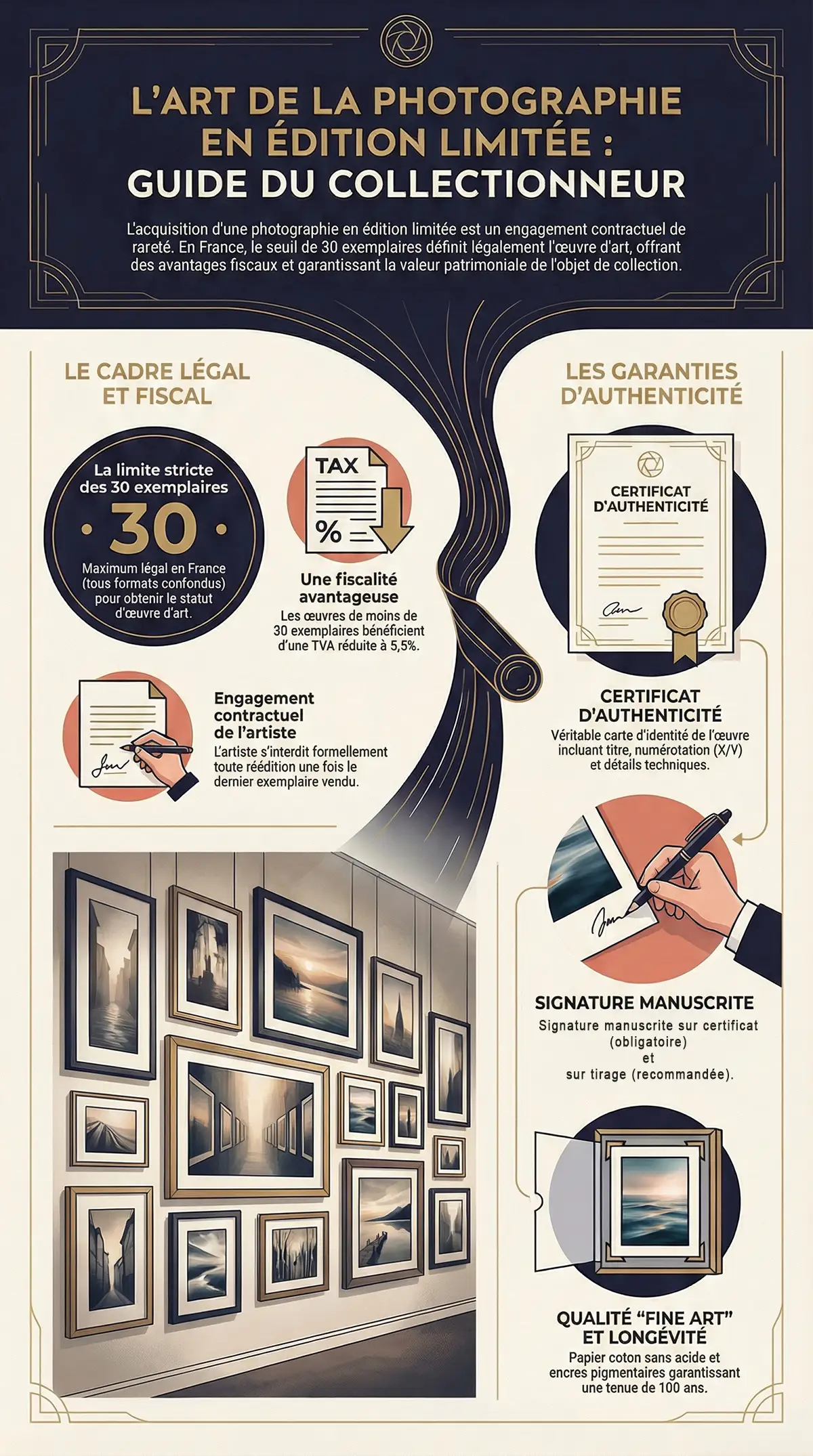
A limited edition, It's not just a commercial label. It's a moral and legal oath. When I engrave "15/30" on one of my prints, I formally undertake never to produce more than 30 copies of this image in all formats.
The end of the print run is final. Once the last copy has been sold, the image definitively ceases to exist on the market. No reissues, no exceptions, no "little extra series because it works well". No more.
It is this tangible and contractual scarcity that forges the value of the work and cements the trust between the artist and the collector. Without this firm commitment, the limited edition concept is meaningless.
The 30-copy tax rule in France
French law is very clear on this point: for a photograph be recognised as an original work of art, it must be limited to 30 copies maximum, all sizes and media combined. It is this legal boundary that distinguishes a work of art from a mere reproduction.
So why do we see series of 50, 100 or even 500 copies? It's often a deliberate choice by the artist to make their work more accessible to a wider audience. collectors, Even if this means giving up our privileged tax status.
In my case, I chose to adhere strictly to the limit of 30 copies. Why? Because I want each person who acquires one of my photographs knows that they belong to a circle of thirty people in the world, not one more.
It is a balance that protects both the value of your acquisition and the heritage dimension of the work.How to recognise an authentic print
Certificate of authenticity and signature

The certificate of authenticity, It is the work's vital identity card. Without it, you have no real guarantee of what you own.
A certificate must it is essential to mention :
- The artist's name
- The title of work
- The copy number in the series (e.g. 12/30)
- The creation date of the work
- The type of paper used (e.g. Hahnemühle Photo Rag)
- The printing technique (pigment inkjet, for example)
- The print dimensions
- The location of the signature on the work (optional but recommended)
The handwritten signature of the artist on the print (on the back or in the white margin) as well as its numbering are the two conditions laid down by French law (Article 98A of the CGI) for a photograph to be recognised as an original work of art. The certificate of authenticity, on the other hand, is not a legal requirement — but it is the mark of professional practice, and the best safeguard to know exactly what you are buying.
Fine Art paper quality and X/Y numbering
The Fine Art paper, It's not a luxury, it's the right thing to do. longevity guarantee of the image. The papers I use (in particular Hahnemühle) are made from cotton or alpha-cellulose, acid-free, This guarantees that they will never yellow over time.
The pigment inks I use are stable for over 100 years old under normal exposure conditions. Your limited edition photography will be passed down through the generations without losing its intensity.
The numbering is always expressed as a fraction : X/Y. The first number (X) is the number of your copy. The second (Y) is the total authorised print run for this image. For example, "12/30" means that you own the 12th copy out of a total of 30 that will ever be produced.
A print run without a visible number is only a commercial reproduction. It immediately loses its status as a collector's item.
Value and price of a limited edition photograph on the market
The progressive pricing strategy: a recognised practice that I don't follow
This is a subject on which I want to be totally transparent with you.
In the art photography, There is indeed a practice of progressive pricing documented: the price of the print run may increase as the edition runs out. The first issues sold (not necessarily issues 1, 2, 3... but the first ones bought) are offered at an "introductory price", and the last copies available may cost two or three times as much.
The Ministry of Culture itself refers to this practice as legitimate:
"It is possible to apply a progression range for the sale of a print. The first issue of a print can be set at a fixed price, but if this image is successful and there are few left on the market, it is justifiable to increase its price. In this way, we can have a price that doubles or even triples between the first and last edition."
This is what it might theoretically look like for a limited edition photo with progressive pricing :
| Sales stage | Time of purchase | Theoretical price | Availability |
|---|---|---|---|
| Launch | First buyers (e.g. issues 1-10 sold out) | 800 € | Strong |
| Mid-range | 11-20 copies sold | 1200 € (+50%) | Average |
| End of series | Last copies sold (21-30) | 1600 € (+100%) | Low |
| Secondary market | Edition out of print | Variable | Resale only |

But that's not what I do.
I have chosen to propose a fixed price for all copies of my editions, no matter when you buy it or which issue you receive. Why do I do this? Because I think it's fairer and more transparent. Whether you trust me from the first print run or discover my work later, you pay the same price for every copy. same price for the same quality.
The quality is strictly identical, whatever the number.
It's important to make this clear: a number 1/30 is not of better quality than a number 28/30. This myth comes from the antique engraving, where the copper plates wore out with each print. In modern digital photography, each draw is rigorously identical in quality.
The progressive pricing system I mentioned above is therefore not linked to the engraved number, but at time of sale over time. A photographer who uses this method increases his price when he has 5 copies left, regardless of whether they are numbers 3, 12, 18, 24 or 29.
I think it's fairer that each collector pays the same price, whether he trusted my work from the start or discovered it later. The rarity of 30 copies already protects the value of your acquisition: there's no need to add an artificial speculative mechanism.
Secondary market and heritage dimension
Once an edition is sold out, it switches to the secondary market These include resale platforms for collectors, specialist galleries and auctions. This is when the artist rating makes perfect sense.
Buy a limited edition photograph, But it's more than just a decorative purchase. It's about building a cultural heritage. The work can be passed on to your children or resold if you wish. It has a tangible, traceable value, protected by its certificate of authenticity.
Avoiding the pitfalls when buying a limited edition photograph
Demystifying false scarcity indicators
Let's be realistic: a 500 copies is not uncommon. It's a quasi-industrial production disguised as exclusivity to justify an inflated price. You don't buy a work of art, You buy a numbered poster.
The quality between numbers is identical Unlike copperplate engraving, where the plate would wear away, a modern digital print is exactly the same from number 1 to number 30. What may vary is only the selling price depending on the time of purchase (if the artist practices progressive pricing), but technically each print is equivalent.
Also beware of pre-printed certificates without handwritten signature real. They have no legal value nor artistic.
Pre-purchase checklist
Before buying a limited edition photograph, Ask the seller or artist these questions:
- Is the image sold under different formats with separate counters, Or are all formats counted together in the 30 copies?
- If this photograph is sold on several platforms, are all the copies counted within the same limit of 30 ?
- Can I see an example of certificate of authenticity ?
- What laboratory makes the prints?
Here are the essential elements to check before buying:
- Presence of a complete certificate of authenticity
- Original handwritten signature of the artist on the print
- Certified fine art paper (Hahnemühle, Canson, etc.)
- Some high-quality inks — ask the lab what longevity is guaranteed
A serious artist must be able to explain his or her approach, his or her choice of limitations, and keep a record of his or her work. accurate sales records. Transparency is the key to trust.
Investing in a limited edition photography, It's not just about acquiring an image. It means owning a piece of history that is certified, rare and protected. It means directly supporting an artist and bringing into your home a work that will touch you every day.
Market rules exist (30 copies for tax status, progressive pricing possible depending on the artist), but each photographer makes their own choices based on their values. Mine are clear 30 copies to guarantee my collectors the status of an official work of art, a fixed price to ensure fairness, and total transparency about my approach.
If this approach appeals to you, I invite you to discover my limited edition photographs. You will find series artistic with varied worlds, sometimes enhanced with drawings to prolong the emotion, offered on Hahnemühle paper, Dibond or Forex, and always delivered with their certificate of authenticity.
Discover my limited editionsFAQ limited edition photography
What is a limited edition photograph?
This is a photograph printed in a strictly limited number (e.g. 30 copies), signed and numbered by the artist. In France, to qualify as a work of art for tax purposes, it must be limited to a maximum of 30 copies in all formats (article 98A of the General Tax Code). Beyond that, it is considered a reproduction. This contractual rarity guarantees exclusivity and protects the value of your acquisition.
Why do some photographers print more than 30 copies?
This is a deliberate artistic choice to reach a wider audience. Editions of 50, 100 or 500 copies make art more accessible, but forgo the privileged tax status (VAT reduced to 5.5%). Personally, I strictly adhere to the 30-copy limit to guarantee my collectors the official status of a work of art and maximum exclusivity.
Does the price of a limited edition increase with each sale?
Yes, this is a common practice known as progressive pricing. The Ministry of Culture acknowledges that a price can «double or triple between the first and last edition». Please note: the increase is linked to the time of purchase (first vs. last buyers), not to the number engraved.
Is the 1/30 number worth more than the 30/30?
No. In modern digital photography, each print is rigorously identical in quality. This myth comes from old-fashioned engraving, where plates wore out. With digital printing, 1/30 and 30/30 are technically equivalent. Some collectors have sentimental preferences, but the quality is strictly the same.
What is an Artist's Proof (AP)?
EAs (or APs in English) are non-commercial prints reserved for the artist's archives or close friends and family. They do not count towards the official quota (an edition 30 may have 3 additional EA prints). Their extreme rarity makes them highly sought-after by discerning collectors, as they are as close as possible to the artist's private life.
How can I check authenticity before buying?
Ask for the full certificate of authenticity with title, artist's name, numbering (X/30), date, paper used and handwritten signature. Ask these questions: «Are all the formats counted together in the 30?», «Is the image sold exclusively by you?», «Can I see the sales register? A transparent artist will answer without hesitation.
Does a limited edition photograph increase in value?
Potentially yes, but never guaranteed. It depends on the artist's reputation, the consistency of his or her work, whether the edition is completely sold out, and demand on the secondary market. Above all, buy for the emotional value: a work that moves you and that you live with every day. The heritage aspect is a bonus, not the main objective.






0 Comments