

Some of the photographs featured in this article are available for sale in limited editions and were produced by Loïc Delplanque, professional photographer in Morbihan.
Introduction

Photography by Loïc Delplanque, on 30 January 2021, during the Justine storm in Le Conquet. A colossal wave crashed onto the sea wall.
These phenomena are part of everyday life in Brittany. They fascinate, worry, stupefy... And while we sometimes end up no longer paying attention to them, they remind us of our fragility and question our relationship with nature.
This article looks at the formation of storms and the storms that have hit Brittany over the years.
It looks at their impact on the coastline, the increased risks associated with climate change, and how the region is adapting to erosion.
Situated at the junction of the English Channel and the Atlantic, it is regularly affected by very active lows from the North Atlantic. Winds Violent storms, huge swells, floods or power cuts: every winter brings its share of bad weather.
Ciaran, Lothar and other major events have left visible traces on the coastline, but also in the collective memory.
Outils Météo Tempêtes Bretagne : Real-time monitoring

Weather Brittany
Moderate rain
🌡️ 9°C (felt 8°C)
🌬️ Wind: 11 km/h direction OSO
💧 Humidity: 94%
🔽 Pressure: 999 hPa ⚠️ Low pressure
👁️ Visibility: 10 km
Heavy rain
🌡️ 8°C (felt 6°C)
🌬️ Wind: 17 km/h direction ONO
💧 Humidity: 96%
🔽 Pressure: 1000 hPa
👁️ Visibility: 10 km
Light rain
🌡️ 10°C (felt 6°C)
🌬️ Wind: 33 km/h direction S
💧 Humidity: 89%
🔽 Pressure: 1000 hPa
👁️ Visibility: 10 km
Mist
🌡️ 11°C (felt 10°C)
🌬️ Wind: 30 km/h direction S
💧 Humidity: 93%
🔽 Pressure: 999 hPa ⚠️ Low pressure
👁️ Visibility: 5 km
Wind Force Calculator
Simply enter the wind speed and the calculator will display its strength directly on the Beaufort scale. This makes it easier to see what a 70 km/h wind really means.
🌊 Historical storms in Brittany
Weather events in the region since 1984
The storms originate in the North Atlantic, generated by depressions resulting from the temperature differences between the poles and the tropics. The jet stream directs them towards Europe, with violent winds. Brittany, the western tip of France, is in the front line of these phenomena.
Since 1980, 182 storms have hit Brittany, according to Météo-France. According to Weather Brittany, the average is three per year. The 1987 hurricane, with its winds at 216 km/h, is still etched in people's memories. Archives mention a major episode as far back as 1287.
7 memorable storms in Brittany

November 1984
On 22 and 23 November 1984, two storms hit the northern half of France, particularly the Brittany. At that time, naming them was not yet done in France or Europe.
The night of 23 to 24 November 1984 will go down in the annals of Brittany's meteorological history. An unusually intense storm hit the region, causing extensive damage and flooding along the coasts.
Gusts exceeded 150 km/h on the Breton coast, with peaks of up to 175 km/h in places.
The town centre of Landerneau, in the Finistère region of France, has been flooded. The raging waves threw tonnes of pebbles onto the coasts, changing the coastal landscape.
These extreme winds uprooted trees, damaged buildings and disrupted infrastructure.
Hurricane of October 1987
The storm of 1987, nicknamed the "Hurricane of 1987", the storm hit Brittany and Normandy with exceptional force, leaving an indelible mark on the region's meteorological history.
An unusual weather episode
On the night of 15th to 16th October In 1987, an explosive low-pressure system swept across north-western France, generating exceptionally strong winds. In Brittany, gusts were measured at 200 km/h in Ushant and 187 km/h in Quimper.
But it was in Granville, on the neighbouring coast, that the absolute record of 216 km/h was recorded - a value that remains unbeaten to this day, even after the passage of Ciaran in 2023.
It left a lasting imprint: a quarter of Brittany's forests were destroyed, tens of thousands of homes were left without power, and material damage was estimated at nearly 23 billion francs nationwide.

This illustrated infographic looks at the consequences of a storm on the Brittany coast.
The Breton landscape was profoundly altered. "The landscape resembled a field of ruins, like Verdun," recalled some inhabitants, struck by the extent of the damage. (source The weather channel)
Despite its intensity, the number of victims remained relatively limited due to a passage and a low tidal range. For many local residents, this night remains one of the most significant weather events of the century.
Considerable damage
The impact was devastating:
- 15 people lost their lives in France.
- The damage was estimated at around 23 billion francs at the time, or 3.5 billion euros.
- Nearly a quarter of Brittany's forests have been destroyed.
An exceptional meteorological phenomenon!
Often mistakenly described as a hurricane, it was in fact a depression in the mid-latitudes. Its atmospheric pressure dropped to 948 hPa in Brest, a record since the station was created in 1945. Its speed, around 110 km/h, helped amplify its devastating effects.
A turning point in storm management
This extreme weather event marked a turning point in awareness of the weather threat in Brittany and Normandy.
It has led to improved warning systems and better preparedness for storms.
Paradoxically, ten years after the disaster, the forestry balance sheet has been positive, with almost complete reforestation of the destroyed areas and the appearance of 30,000 hectares of new forests.
The October 1987 hurricane remains etched in the collective memory as a reminder of the power of nature and the need for constant vigilance in the face of extreme meteorological phenomena.
Daria (25 and 26 January 1990)

Daria in January 1990: sandstorm on the Boulevard Barnaart (Netherlands), wind force 12. Fotopersbureau de Boer
January 25–26, 1990. Storm Daria, also known as the Burns’ Day Storm, marked the beginning of a winter many Bretons won’t forget. This cyclone bomb hit hard, with gusts measured at 176 km/h at the Pointe du Raz and violent swells that shook the entire coastline from the English Channel to the Atlantic (source: Wikipedia).
And that was just the beginning. Daria paved the way for an impressive series of at least ten storms, including Vivian, Herta and Wiebke, which swept through the forests, destabilised the power grids and left a lasting mark on the memories of those who lived through them (source: Wikipedia).
93 dead in six countries. Daria didn't just shake the roofs, she changed lives. There were 45 deaths in the UK, 19 in the Netherlands, 10 in Belgium, 8 in France, 7 in Germany and 4 in Denmark. A brutal episode, the human consequences of which have left their mark on Europe (source: Wikipedia).
Herta (3 February 1990)

19/20 FR3, 4 February 1990 - Herta, a murderous episode in France.
INA archive, available on YouTube.
Herta hit France in the middle of the day, an unusual passage for this type of phenomenon.
Devastating winds
It was the second strongest storm in 50 years in the northern part of the country.
From 9 a.m. onwards, extremely powerful winds swept across Brittany, reaching speeds of 167 km/h at the Pointe du Raz and 162km/h at Belle-Île-en-Mer. At the same time, Normandy was hit by gusts of up to 170 km/h in Granville.
As the storm moved inland, gusts reached 133 km/h at Nantes (Pays de la Loire) and 151 km/h at Cap de la Hève, near Le Havre in Seine-Maritime (Normandy). Herta then hit the Île-de-France region, where winds peaked at 158 km/h at Brétigny-sur-Orge.
A heavy human and material toll
In France, 23 people lost their lives that day. Among the regions hardest hit, Brittany was not spared.
In Herbignac, a resident recounts:
"The wind was blowing at over 120 kph continuously, gusting to 140 kph; a huge branch almost as wide as the road fell behind my car... My wife was shaking with fear, and scanned the windows hoping they would hold." (source: infoclimat)
In Pipriac, a lorry driver was killed when a tree fell. Three other people were seriously injured when bay windows were blown out during the storm.
Material damage was extensive: the church in Brielles lost its steeple, buildings were damaged in Rennes, and businesses suffered damage in Cancale and Vitré. Throughout the region, many trees were uprooted (source: Ouest France)
Lothar and Martin (December 1999)

Damage in Angoulême on the morning of 28 December 1999, after storm Martin.
Nicolas Dessaux - Personal work
Lothar and Martin, which hit Brittany on 26 and 27 September. December 1999, left their mark on the region's history with their exceptional violence. These meteorological events have been described as the "storms of the century" because of their intensity and considerable impact.
They have caused 140 deaths in Europe, including 92 in France alone.
Entire forests were destroyed, farms were severely damaged, and roofs were torn off. The power grid suffered heavy consequences, leaving some cities, including Rennes, without electricity for a time.
A dramatic accident claiming 4 victims on the RN12 was a reminder of the brutality of the events. More than 150,000 homes without electricity, emergency services overwhelmed... Lothar only lasted a few hours, but its passage left a stunned region. As this video shows.
Lothar struck the Breton coasts on December 26, bringing extraordinarily strong winds.
Record gusts were recorded:
- 184 km/h on the island of Ouessant
- 173 km/h in Saint-Brieuc, the regional record for this event
- 158 km/h at Pleyber-Christ
There are many accounts of Lothar, and they all say the same thing: nobody was prepared for such violence.
On the night of 26 December 1999, Brittany was hit hard. In the Trégor region, residents woke to the sound of gusts of wind, discovering in the early hours of the morning roofs blown off, roads blocked and trees on the ground.
Martin followed the next day, 27 December, particularly affecting the south of Brittany.
It strikes a more southern area of Brittany than the first storm, but with similar strength.
It is having less of an impact on the region, but the Loire-Atlantic is suffering considerable damage, particularly to its forests.
The power grid is affected once again, while the estuaries and coasts experience flooding.
In Ille-et-Vilaine, the damage was extensive, and five people lost their lives: four in a vehicle hit by trees in Montauban, and another in Boussac, after the roof of her house collapsed.
(sources : The weather channel) - See photographs of storms in Brittany
Justine (30 January 2021)

30 January 2021, storm Justine at Le Conquet. A powerful wave rises up, evoking the silhouette of a dragon. Photograph by Loïc Delplanque
Loïc Delplanque: “During storm Justine, the waves were hitting harder than usual. Soaked, I was heading back to the car when it emerged from the sea. What’s beautiful about waves, beyond the power they give off, is the imagination they spark. Some will see a simple wave, I see a dragon from the seas. And you, what do you see in this photo?”
Justine hit Brittany on 31 January 2021.
With winds reaching almost 150 km/h, it caused flooding, power cuts and property damage.
The coasts were violently battered by impressive waves. Residents had to cope with extreme weather conditions, a reminder of man's vulnerability in the face of nature.
Ciarán (1ᵉʳ to 2 November 2023)
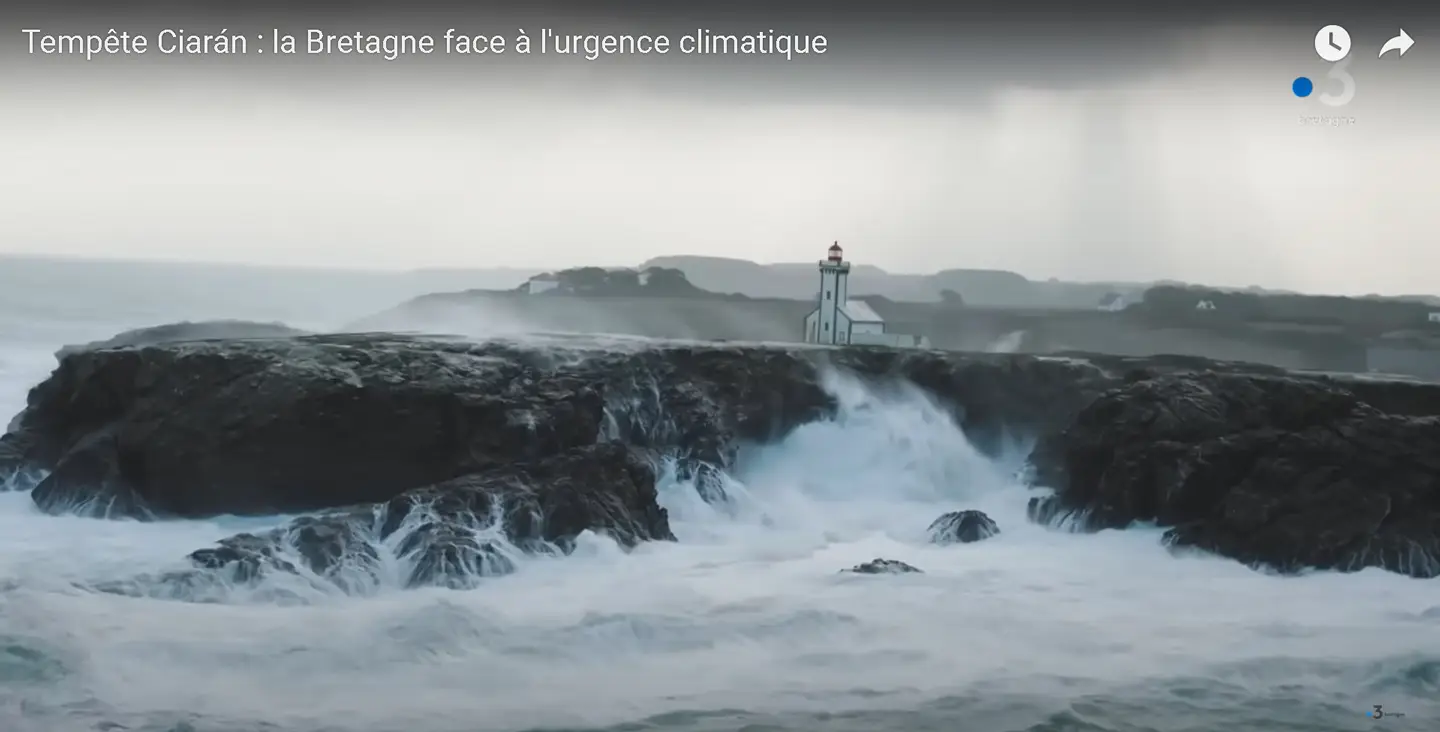
Enquêtes de région Le Mag: Tempête Ciarán - la Bretagne face à l'urgence climatique.
Report broadcast on France 3 Bretagne, presented by A. Masteau.
One year after the night of 1er to 2 November 2023, this documentary looks at the human, economic and climatic consequences of Ciarán in north-west France.
Ciarán, on the night of 1 to 2 November 2023, was exceptionally violent. Some media were quick to describe it as the "storm of the century".
Four people lost their lives in France during the passage of Ciarán. In Brittany, an Enedis technician died in Pont-Aven while working to restore electricity.
Extraordinarily strong winds
Ciarán generated gusts of wind of an intensity rarely seen in Brittany :
- 207 km/h recorded at Pointe du Raz in Finistère, setting a new record
- 193 km/h measured at Plougonvelin, also in Finistère
- 180 km/h recorded on the island of Bréhat in the Côtes d'Armor
Even inland, the winds remained very violent:
- 125 km/h at Rostrenen in Côtes d'Armor
- 108 km/h recorded at Rennes in Ille-et-Vilaine
Extensive damage
The consequences of Ciarán have been devastating for the region:
- Many trees uprooted and roofs damaged
- Roads cut off and marinas devastated
- Around 1.2 million homes without electricity in France, many of them in Brittany
I went to the Perharidy peninsula a few days after the storm. It had left its mark everywhere. Dozens of trees down, paths blocked, embankments gutted. It was a desolate sight.
We often hear about winds of over 200 km/h, power cuts and material damage. But when you're there, when you see these familiar landscapes disfigured, it takes you by storm. Every tree on the ground is a reminder of just how much can change overnight.
That day, I also learned that the Ponthus beech in the Brocéliande forest had also been felled. An emblematic tree, full of stories, walks and memories for many.
Key statistics
When we think of storms in Brittany, we often think of the wind. But it's not just the gusts. Some data are just as impressive

Illustration of a Breton lighthouse in the face of bad weather: when the sea strikes relentlessly during a winter gale.
Unusual waves
Here are some of the record wave heights seen on Brittany's coasts in recent decades. All these heights come from precise measurements or reliable estimates:
- 24.60 metres. This is the height of a wave recorded at the Mare lighthouse during the winter of 2017-2018.
Sensors installed on site, combined with an image analysis system, have made it possible to measure it precisely. When you think of the isolation of this lighthouse on the open sea, you can imagine what it must feel like to be faced with such a mass of water, in the noise, wind and spray.
(Source: measurement campaign at La Jument lighthouse, winter 2017-2018 - see also Wikipedia entry on the lighthouse)
- 21.1 metres. This is the height of a wave measured off the coast of Finistère during the passage of storm Ciaran, on the night of 1 to 2 November 2023.
This value was recorded near the Pierres Noires buoy, south of Ushant, the most westerly point in mainland France.
The significant height of the waves had already reached 11.7 metres, but this isolated breaker exceeded 21 metres, the equivalent of a six-storey building.
This is an impressive figure, and a reminder of the violence of the phenomena on this part of the coast exposed to the great swells of the North Atlantic.
Inland too, the impact was brutal.
In Guingamp, Aurélie, aged 48, says she was woken up at 4am by "a huge noise". A tree in her garden split in two: "It didn't go far. Within a few degrees, it was a disaster...".
(Sources: The Weather Channel and Le Parisien via Aurélie's testimonial)
- 23.60 metres. This is what the Pierres Noires buoy measured during the Petra storm off Molène in early February 2014.
For more than ten hours, the waves stayed above 14 metres. A violence that did not stop at sea.
In Lomener, Ambroise Le Floc'h recalls: "the wind in the shutters, with the shutters slamming a lot; you can hear the swell hitting the sea wall...".
(Sources: Infoclimat, Le Point)
- 16 metres. That's the size of the waves recorded on Ouessant and Belle-Île-en-Mer during the storm of 16 October 1987, driven by a long and powerful swell along the entire Breton coastline.
The sea level rose by 1.7 m in Brest and Le Conquet, despite a low tidal range.

A number of residents still remember it:
"My grandmother lived in Cancale: her house shook in the gusts, right down to her bed. Even the windows vibrated", recalls a member of Infoclimat, recalling that night when the wind "cannonades" were raging and all the boats in the port of Concarneau were clinging to the ramparts.
A night when the sea and the wind spoke loudly - and all of Brittany had to listen.
(Sources: Wikipedia, Infoclimat)
- 17.7 metres above sea level - Jument lighthouse
On 3 January 2018, at the Jument lighthouse on Ushant, several exceptionally high waves - known as "scélérates" - were observed. One of them reached 17.7 metres above sea level, the height of its crest. The most impressive wave that day was measured at 24.6 metres from trough to crest.
(Sources: Wikipedia)
Where can you watch the storms in Brittany?
The most exposed areas
Brittany is one of the regions most exposed to storms, especially on its coasts.
Places like the Pointe du Raz, Ushant, the Crozon peninsula and the Bay of Mont-Saint-Michel regularly experience extreme conditions. Violent winds, high waves, exceptional tides and submersions follow one another every season.
During episodes like Ciarán, these areas were particularly hard hit. Some port cities, such as Brest, Lorient and Saint-Malo, regularly suffer major material damage.
Estuaries and low-lying areas remain vulnerable to flooding. In the face of these many dangers, the authorities are reminding people of the importance of constant vigilance.
The Four lighthouse

Photograph taken on 29 January 2020 by Loïc DelplanqueOn 30 January 2021, during the Justine storm in Le Conquet. A colossal wave crashes onto the sea wallduring a violent storm off the coast of the Four lighthouse. Its framed version is on display next door.
The Four lighthouseIt is well known for the huge waves that crash against its walls during storms. First lit in March 1874, it lies between the English Channel and the Atlantic.
It can be seen from the GR34 at Landunvez and Porspoder. Built over four years on the rock of Le Four, it resembles the Pierres Noires lighthouse. These twin lighthouses guide sailors through the dangerous Le Four channel.
At the Four lighthouse, the spectacle is as impressive as it is worrying. These phenomena can also be deadly.
On 27 April 1873, when construction of the lighthouse was not yet complete, a "dull wave" capsized a boat carrying supplies and materials, killing three sailors.
Despite the repeated assaults of the elements, the Le Four lighthouse has withstood the most extreme conditions.
Its sturdy construction and strategic position have enabled it to withstand the vagaries of the sea d'Iroise.
However, certain traces remain visible: on 1 February 1904, it was struck by lightning, causing extensive damage.
Even today, the Four lighthouse remains a symbol of resilience in the face of the waves.
The wild Morbihan coast

Photograph taken on 21 October 2022 by Loïc Delplanque on the wild Morbihan coast. A huge wave submerges a rock off the coast.
The wild coast of Morbihan, with its steep cliffs and secluded beaches, it is often exposed to the raging elements, particularly during the winter months.
These extreme weather phenomena are characterised by powerful winds and impressive waves that shape the coastal landscape.
The storms on this coast can generate gusts frequently exceeding 100 km/h, with records sometimes reaching 150 km/h during the most intense episodes.
These violent winds, combined with the particular topography of the coast, create spectacular and dangerous sea conditions.
The waves generated by these storms can reach considerable heights, sometimes in excess of 10 metres.
These extreme conditions often attract curious onlookers and photographers, but represent a real danger to the safety of people and coastal infrastructures.
The local authorities regularly take precautionary measures during these events, such as closing certain access points to the coast or issuing warnings to the population.
The Côte Sauvage du Morbihan also lives to the rhythm of these phenomena, sometimes violent.
Storms and climate: understanding the issues

Maritime illustration - A sailboat sails by a lighthouse in the sunshine.
The role of climate change
Climate change is already making itself felt in Brittany, with warming of +1.4°C since the 1960s. By 2100, the rise could reach +4°C.
Years such as 2022, which are considered very warm today, would then become rather cool years.
Droughts will be longer and more intense: soils will remain dry for an extra month, and their intensity could rise by 47 %. Conversely, winter rainfall will increase by 14 %, with more frequent extreme events (+9 to 44 %), which will increase the likelihood of flooding.
River flows will fall by 37 % at the end of the summer, extending the low-water period (when water levels are at their lowest) by a month.
Sea levels could rise by between 36 and 69 cm, making flooding more frequent.
The Atlantic Ocean, which is warmer and more acidic, will experience marine heat waves more often.
And forest fires could gain 25 days a year of favourable conditions.
An increasingly contrasted climate, between water shortages and sudden excesses.
Impact of global warming on storms
Climate models predict a northward shift in trajectories, with more intense winds in winter.
In Brittany, this type of change comes on top of other effects of global warming - rising sea levels, more vulnerable coasts, more extreme rainfall. The following points outline the main impacts.

Global warming - Illustration showing the Earth in character, affected by drought and heat.
Global warming : Since the end of the 19th century, the sea level in Brest has risen by around 30 cm, according to available tide gauge measurements. This rise has accelerated over the last few decades, reflecting a global trend linked to climate change global warming.
Coastal vulnerability : The low-lying areas of Brittany's coastline, as well as certain islands, are particularly exposed to the risk of marine submersion. Communities such as Treffiagat in Finistère have had to demolish houses threatened by coastal erosion and rising sea levels.
Intensification of extreme events : Global warming is leading to an increase in the frequency and intensity of extreme rainfall events, as well as accelerating coastal erosion. These phenomena are being observed in Brittany, where episodes of heavy rain are becoming more frequent and more intense.
Shifting storm tracks : Climate models predict a northward shift in trajectories in the North Atlantic, which could modify Brittany's exposure to these events. This development is linked to changes in atmospheric currents brought about by global warming.
Combined impact on the communes of Brittany : The rise in sea level, combined with the intensification of storms, is increasing the threat to many of Brittany's communes. Although the figure of 93 communes is mentioned in some reports, it is important to note that exposure varies depending on the locality and the protection measures in place.
In Brittany, rising sea levels combined with increasingly violent weather episodes are already exposing more than 130,000 residents to the risk of marine submersion.
This phenomenon threatens low-lying areas and islands in particular, with potentially serious consequences for infrastructure and local populations.

Coastal erosion: a phenomenon amplified by climate change
Brittany, with its 2,470 km of natural coastline, is particularly exposed to coastal erosion.
This phenomenon, already long-standing, is now exacerbated by rising sea levels and the intensification of storms, direct consequences of warming.
According to Cerema, around 9% of the Finistère coastline, or 120 km, is affected by erosion, mainly impacting sandy and loose coasts.
Brittany's coastal communities face major challenges in adapting their urban planning and protecting their infrastructure.
In response, the Brittany region adopted in February 2024 a guidance document to help local authorities integrate erosion risks into their local planning policies — a first in France on this scale.

Economic and environmental consequences
Coastal erosion in Brittany is having a significant economic impact.
Damage to infrastructure, housing and economic activities such as tourism and oyster farming represents significant costs for local authorities.
For example, the storms of winter 2013-2014 caused considerable damage to the Breton coastline, requiring substantial investment in repairs and the introduction of protective measures.
Environmentally, erosion disrupts coastal ecosystems, leading to loss of biodiversity and degradation of natural habitats.
The disappearance of dunes and wetlands reduces the natural capacity of the coastline to absorb the impact of tides and storms. climatic increasing the vulnerability of these areas.
Measures to protect and adapt the area
Local authorities in Brittany are implementing integrated coastline management strategies (i.e. they are taking into account the entire coastline, its uses and natural changes), relying on the natural resilience of ecosystems (their ability to regenerate or adapt in the face of storms, erosion or rising sea levels).
The Litto'Risques partnership helps local authorities in Finistère to adapt to changes in the coastline.
Based on local observation and awareness-raising, it proposes technical solutions to municipalities vulnerable to erosion.
Brittany's storms, from the hurricane of 1987 to Ciaran, reveal a history marked by strong winds. violent and property damage.
Faced with rising sea levels and intensifying climatic phenomena, Brittany is adapting its protection strategies, such as the Litto'Risques partnership.
Understanding these issues will enable us to better anticipate hazards, preserve our coasts and ensure the resilience of an area where the nature, unpredictable, demands respect and vigilance.
Brittany in the face of storms: a Thalassa report

Brittany has always lived with storms. They are part of its identity, its landscape and its collective memory.
But with global warming, their frequency, intensity and consequences are changing. Floods, submersions, extreme winds, impressive swells... everything is getting worse.
Observing, understanding and anticipating these phenomena is becoming essential. Not to give in to alarmism, but to adapt - intelligently.
Because every piece of data, every reading, every weather map becomes a little compass to help us live better in a land where nature sometimes imposes its own rules.
Frequently Asked Questions about Storms in Brittany
What is the strongest storm ever recorded in Brittany?
The storm of October 15, 1987, is often considered the most violent to have hit Brittany. Wind gusts reaching 200 km/h were recorded in Ouessant, causing significant material and forest damage.
What was the biggest storm in France?
Since 1980, storm Lothar, at the end of December 1999, is considered to have been the most severe storm to hit France. It swept across the north of the country, with gusts often exceeding 140 km/h, from Brittany to Alsace.
Other notable storms include Martin (December 1999), Klaus (January 2009), Xynthia (February 2010) and more recently Ciaran (November 2023), each of which left its mark in terms of intensity and damage caused.
How many storms hit Brittany each year?
The number of storms affecting Brittany varies considerably from year to year.
Some years, the region can be hit by several storms, while other years are calmer.
Since 1980, more than 180 events have been recorded across the entire region.
Which areas in Brittany are most exposed to storms?
The coasts of Finistère, such as Ouessant, Pointe du Raz, or Plougonvelin, are among the most exposed areas. The wild coast of Morbihan, Belle-Île, and the Breton islands are also regularly affected.
Where will you be living in Brittany in 2050?
It is difficult to identify absolutely "safe" areas in Brittany in 2050, but low-lying coastal areas are the most threatened by rising sea levels. water. Sites such as the islands of Molène, Sein and Glénan and parts of the coastline around Morlaix could disappear.
Areas inland and at a higher altitude are preferable. It is crucial to take into account the risk of uninsurability of certain properties, particularly in Northern Brittany and on the Mediterranean coast.
When do storms most often occur in Brittany?
The storms mainly hit Brittany between November and March, when the Atlantic lows are most active.
How do storms affect fishing in Brittany?
Storms in Brittany have a significant impact on fishing. They can sweep away entire ships, resulting in the loss of human lives, as the history of the Terre-Neuvas testifies.
The storm of 1930 is considered to be the deadliest of the 20th century for the French navy. More than 200 fishermen, mainly from Brittany, lost their lives when their dinghies were caught in a violent storm south of Ireland.
English: Is climate change making storms more frequent or more intense?
There is as yet no scientific consensus on a significant increase in the frequency or severity of the disease. intensity storms in Brittany.
On the other hand, some studies suggest that weather systems are becoming more unstable, with phenomena that are sometimes more localised or intense.
What should you do in case of a weather alert in Brittany?
It is recommended to stay sheltered in a solid building, to close shutters and windows, and to limit movement. Outdoor objects, vehicles, and important documents must be secured. It is also advisable to prepare a flashlight, a battery-powered radio, drinking water, and any necessary medical treatments. In case of alert, follow the instructions of the authorities, avoid using the phone to avoid overloading the lines, and do not take the car, even to pick up a loved one.
Where can you get information during a storm in Brittany?
The websites of Météo-France, the prefectures, and the official social media accounts of local authorities provide real-time alerts and instructions. Local radio stations also remain a reliable source of information in case of internet outages.








He pasado un invierno en Bretaña hace años y todavía recuerdo el sonido de las olas durante las tormentas. Me ha gustado mucho el artículo.
Muchas gracias, Javier. Me alegro que el artículo te haya recordado esos momentos. ¡Un saludo desde Bretaña!
It's hard to forget the storm of 1999... We spent the night without electricity, and the next day the whole neighbourhood was turned upside down. Your article reminded me of those moments, thank you for sharing.
Thank you very much for your message. They are indeed vivid memories, even if we could do without them. Thank you for sharing your experience.
Was ich bis jetzt gelesen habe, ist alles sehr interessant beschrieben und ich bin nun erst richtig neugierig geworden...
Vielen Dank für Ihr feedback! It's good to know that the article you're interested in has been published. Viel Spaß beim Weiterlesen!
Interesting wind calculator, you don't always realise how strong the wind is.
Thanks for your feedback. It's true, putting a number on the wind strength helps you to get a better idea of what it really represents.